

A Buddhist Monastic
construction

A monastery
for all
for all
Building clusters with courtyards in the middle, extending symmetrically from the symbolic centre axis. A blend of western and eastern architecture elements. Our monastery—a serene space where Buddhist nuns can study and practice.
But, it is much more than that.
From these grounds, we hope that future geshemas (Buddhist female scholars having undergone the academic training and rigour of at least a PhD in Buddhist philosophy) will emerge, forming the future epicenter of Buddhist learning for females.
From these grounds, we hope to share with everyone how we have applied our learning in practical ways, how our lives have changed for the better. And we hope that others can do so too.
A monastery for all.
But, it is much more than that.
From these grounds, we hope that future geshemas (Buddhist female scholars having undergone the academic training and rigour of at least a PhD in Buddhist philosophy) will emerge, forming the future epicenter of Buddhist learning for females.
From these grounds, we hope to share with everyone how we have applied our learning in practical ways, how our lives have changed for the better. And we hope that others can do so too.
A monastery for all.
A visual
Image for visualization purposes only—subject to change.
What’s next
For the next phase, we expect to construct Buildings 3 and 4 in Living Quarters - East (see image for visualization purpose—subject to change). We will be submitting an application for a building permit before commencing construction.
Timeline
of Events
of Events
2018 August 12
Groundbreaking ceremony2021 September
North Lotus: Building 1 started2024 July
North Lotus: Building 1 & 2 completedNotable
Architectural Features
Architectural Features
Symmetry and Balance: The Courtyard Layout
The architecture of a traditional monastery pays special attention to symmetry, where buildings extend from both sides of the centre axis, to form a balanced building cluster. The monastery is made up of such building clusters, each comprising four buildings surrounding a courtyard. Through these clusters, one can observe the importance placed on balance as well as order. For Buddhists, the centre axis symbolizes relying on the Middle Way as a foundation for our practice and having a broad perspective of things.
Rooftop Corners Curving Upwards
Another iconic feature of traditional monastery architecture is where the four corners of the rooftop curve upwards. The face of the roof, covered with tiles, is gently sloping. This creates an imagery where the roof is like a majestic bird, wings extended, poised to soar. An embodiment of the traditional philosophy where humans and nature are one, this imagery also represents our aspiration to soar on the wings of compassion and wisdom.
Gable Pendants
Within a traditional monastery building, one can identify many symbols expressing wishes for auspiciousness, peace and other positive things. They represent well-wishes to the world from the nuns learning in this monastery.
The Suspended Seat
The railings on the second floor create natural suspended seats with backrests. In ancient times, many famous poets and philosophers would rest on suspended seats to ponder and look afar, creating many classic compositions in the process. Here, they serve as decorative elements, bringing to mind the many nuns deep in contemplation as they gaze into the distance.
Pavilion Styled Structures
These structures are where Buddha statues or sacred objects are enshrined. They also serve as vantage points. These structures remind us that we should set our goals high and stay resolute in our mission of preserving Buddhism.
Finial
Typically situated at the cusp of the pavilion-styled structures, it is shaped like the “Mani” jewel in Buddhism. It symbolizes auspiciousness and virtuous aspirations coming to fruition.
Chime
Hanging from the eaves of the monastery, it symbolizes blessings and warding off mishaps. The sound of these chimes represent the prayers from our monastery being spread to all corners of the world. We hope that everyone who hears it feels refreshed in body and mind.
Building Material
Exterior Walls
All the building walls utilize Insulated Concrete Forms (“ICF”), increasing energy efficiency. Stucco was used to create the exterior of a traditional monastery building.
Roof Tiles
We used environmentally friendly materials to create 100% recyclable composite roof tiles with the look and feel of traditional ceramic tiles, re-creating the elegance of a traditional monastery roof top. The entire installation was completed locally - no small feat.
Exterior Landscape
Lamps along the PathwayFor the Buddhist nun, a brightly-lit pathway symbolizes the practitioner’s path to enlightenment.
Each step -
Filled with dedication and good intentions
Each step -
Closer to self-realization
Closer to full wisdom and compassion.
FAQ
Currently, GWBI expects its monastery campus to be as shown in the below (image for visualization purposes only and subject to change).
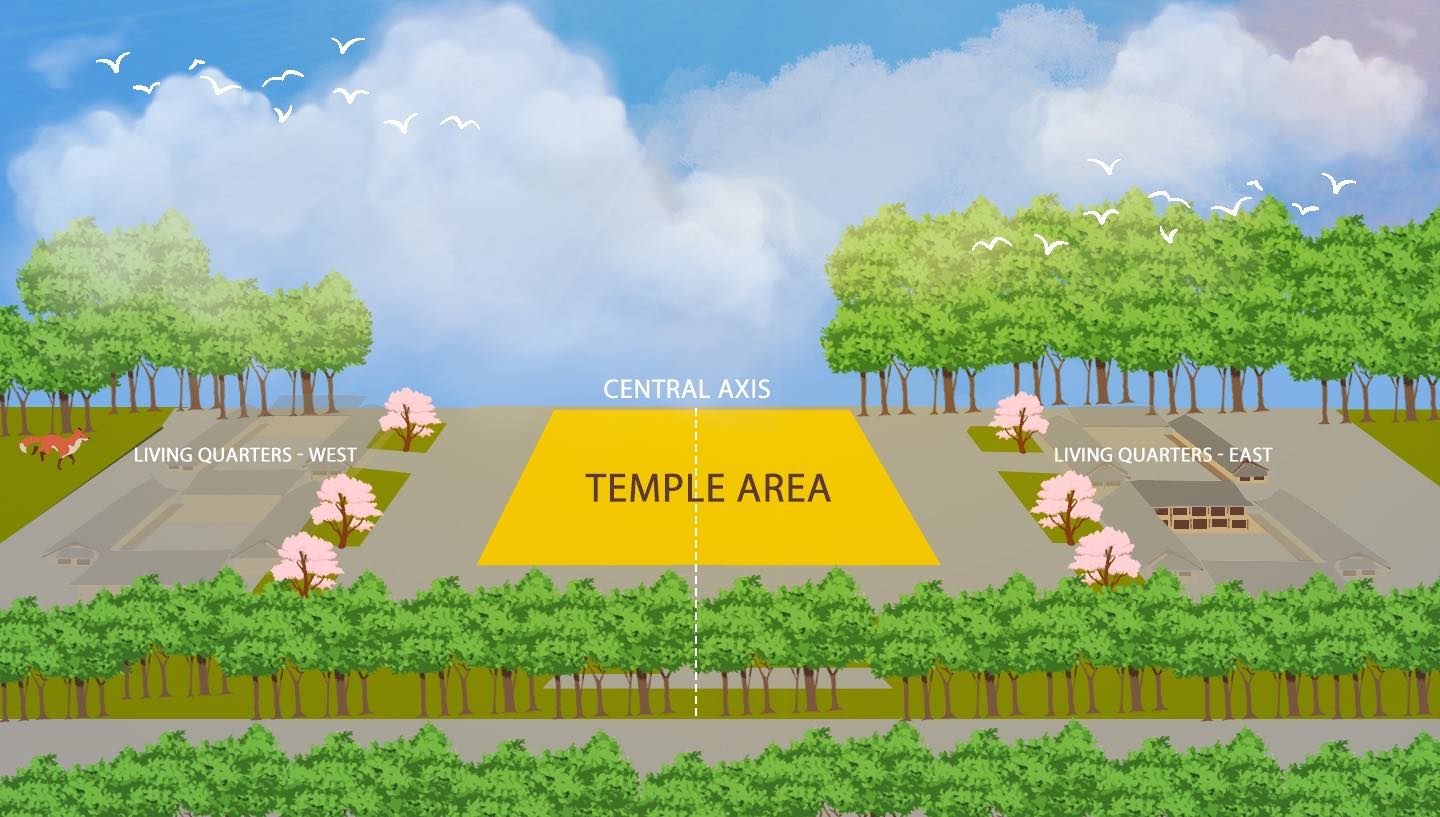
Typically a Buddhist monastery consists of a prayer hall, dining hall, living quarters, and classrooms.
Typically a Buddhist monastery consists of a prayer hall, dining hall, living quarters, and classrooms.
Since 2012, nuns have continuously enrolled in our prestigious 16-year Buddhist curriculum, dedicating their lives to studying and preserving Tibetan Buddhism. Not many people in the world choose this path. As such, we would like to support every individual who does by building a campus for their study and practice.
Our current priority is to complete the construction of living quarters on the east side, as well as its supporting infrastructure, to provide living space for the students and nuns continually being enrolled. We currently plan to have seven main buildings on the east side, of which two have already been built. The progress of our construction is contingent on building permit approvals and sufficient funds being raised.
Our current priority is to complete the construction of living quarters on the east side, as well as its supporting infrastructure, to provide living space for the students and nuns continually being enrolled. We currently plan to have seven main buildings on the east side, of which two have already been built. The progress of our construction is contingent on building permit approvals and sufficient funds being raised.
The maximum capacity of North Lotus is expected to be 1,400. With new nuns and students enrolling each year, we expect to reach capacity in 20 years or more.
We hired Nine Yards Studio, a local architect and WM&M (1993), a local general contractor to work on our monastery construction. As we hope to support the local community, we asked WM&M (1993) to hire local Eastern PEI workers as much as possible. In addition, most of our construction materials are sourced locally.
Similar to a post-secondary education campus, we have students living on our monastery grounds. Security measures, such as a boom gate for check-in purposes, are in place to protect their personal safety. These measures are similar to those at UPEI and Holland College. Over the years, we have experienced several security incidents involving trespassing individuals, some of whom were intoxicated. Infractions include breaking into, stealing, as well as vandalizing property. We were fortunate to have security measures in place to minimize the damage and impact.
As Buddhist nuns, upholding our monastic precepts, some of which involve codes of conduct when interacting with the opposite gender, is a critical part of our practice. Our security measures, which include receiving visitors during a specified time frame also help us uphold our precepts.
GWBI welcomes visitors who would like to learn more about us. We would be happy to schedule visits with those who are interested.
There will NOT be a hospital, police station, fire station nor secret tunnels on the GWBI campus.
As Buddhist nuns, upholding our monastic precepts, some of which involve codes of conduct when interacting with the opposite gender, is a critical part of our practice. Our security measures, which include receiving visitors during a specified time frame also help us uphold our precepts.
GWBI welcomes visitors who would like to learn more about us. We would be happy to schedule visits with those who are interested.
There will NOT be a hospital, police station, fire station nor secret tunnels on the GWBI campus.
Yes. Per provincial regulations, Great Wisdom Buddhist Institute pays property taxes at an institutional rate (higher than the residential rate), 1.5% based on taxable assessed value. Only the prayer hall in Uigg is tax exempt. All other buildings and land in Brudenell and Uigg are taxed (as per Real Property Tax Section 3.1.a.).
Click here for more FAQ.